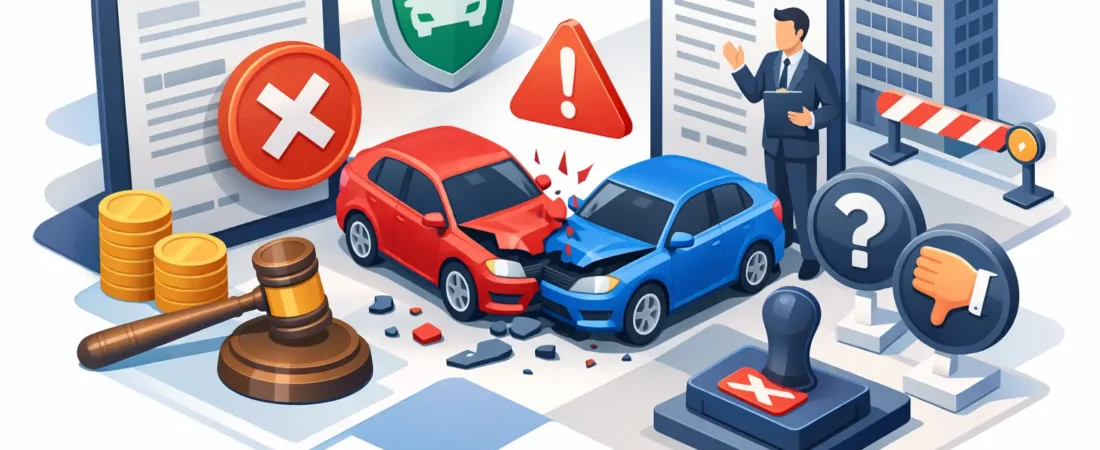
An insurance denial can feel like a second hit after a serious crash. You are dealing with pain, appointments, missed work, and bills, then an adjuster tells you there is no coverage or that your injuries are not worth what you claimed. The top reasons claims get denied are often tied to evidence, timing, policy rules, or statements made before you understood what was at stake.
A denial is not always the final word. Insurance companies make decisions based on the information they have, the language in their policy, and their financial interest in paying as little as possible. In many cases, a denial can be challenged with stronger evidence, a clear legal response, or a closer review of Minnesota insurance law.
Top Reasons Claims Get Denied in Minnesota
Minnesota crash claims can involve more than one type of insurance. Your own Personal Injury Protection, or PIP, coverage may pay certain medical expenses and lost wages regardless of who caused the accident. A claim against the at-fault driver may cover losses PIP does not fully address. Each claim has different rules, and insurers may use confusion between them to delay or deny payment.
The insurer says you caused the crash
Fault disputes are one of the most common reasons a liability claim is denied or reduced. The other driver may say you were speeding, distracted, following too closely, or failed to yield. Sometimes the insurer reaches that conclusion based only on its insured driver’s version of events.
Minnesota’s comparative fault rules can affect your recovery if you share blame for a collision. That does not mean you have no claim just because the insurer points to something you may have done. The details matter. Traffic camera footage, photos of vehicle damage, witness statements, the police report, roadway design, and accident reconstruction can all change the picture.
Do not assume the police report settles fault either. It can be valuable evidence, but it is not always complete or correct. A lawyer can investigate beyond the report and preserve evidence before it disappears.
There is not enough proof of what happened
Insurance adjusters look for gaps. If there are no crash photos, no independent witnesses, or no documentation showing how the collision occurred, they may argue that their driver was not responsible. This can be especially difficult in intersection crashes, lane-change collisions, pedestrian accidents, and rideshare crashes where multiple parties may be involved.
You can strengthen a claim by saving what you have early: photographs, video, the names of witnesses, damaged property, medical paperwork, and messages from the other driver. If you reported the crash, request the report when it becomes available. If nearby businesses, homes, or vehicles may have video, move quickly. Many recordings are deleted within days or weeks.
You waited too long to seek medical care
An insurer may argue that an injury was not caused by the crash if you waited days or weeks to see a doctor. This is a common tactic after soft-tissue injuries, concussions, and back or neck pain, which may not fully appear at the accident scene.
A delay does not automatically destroy a claim. People often believe they are merely sore, have trouble getting an appointment, or need to care for their family before seeking treatment. Still, prompt medical evaluation is usually the best protection for both your health and your case. Tell your provider about all symptoms, even if they seem minor at first, and explain that they began after the accident.
The insurer blames a preexisting condition
If you had a prior back injury, arthritis, a previous concussion, or another medical issue, the insurance company may claim your current pain is unrelated. They may review years of records hoping to find a reason to minimize what the crash changed.
A preexisting condition does not give another driver’s insurer a free pass. A collision can aggravate a prior injury or make a manageable condition much worse. The key is medical evidence showing your condition before and after the crash, your treatment needs, and how the injury has affected your ability to work and live normally.
There are gaps in treatment or missed appointments
Insurers often treat missed appointments, long breaks in care, or failure to follow a treatment plan as proof that an injury was not serious. But real life is rarely that simple. Transportation problems, work demands, childcare, financial pressure, and referral delays can all interrupt treatment.
If treatment is interrupted, keep records and communicate with your medical provider. Do not simply stop going because you are frustrated or worried about bills. A clear explanation for a gap can matter. So can a doctor’s opinion about why ongoing care, therapy, medication, or restrictions are medically necessary.
A recorded statement created problems
An adjuster may call shortly after a crash and sound helpful. They may ask for a recorded statement, request broad medical authorizations, or press you to describe injuries before you have been evaluated. A simple answer such as “I’m fine” can later be used to argue that you were not hurt.
You generally should not guess about fault, speed, injuries, or what you could have done differently. Stick to basic facts if you must speak with an insurer, and do not accept a settlement or sign a release before you understand your medical outlook. Once you settle, you may lose the right to seek more compensation if your condition worsens.
The policy has a coverage issue
Not every denial is about fault or injuries. The insurer may claim the driver was excluded, the policy had lapsed, the vehicle was being used for an excluded purpose, or there is a dispute over who owned or had permission to use the vehicle. Uber and Lyft accidents can add another layer because coverage may depend on whether the driver was logged into the app, waiting for a ride request, en route to a passenger, or carrying one.
Coverage issues require careful review. Do not take an adjuster’s verbal explanation as the complete answer. The relevant policies, notices, declarations pages, and accident facts should be examined closely. Your own uninsured or underinsured motorist coverage may also be available when the at-fault driver has little or no insurance.
Deadlines or notice requirements were missed
Minnesota law sets deadlines for legal claims, and certain cases have much shorter notice requirements. Claims involving a city, county, state agency, school district, or other government entity can be particularly time-sensitive. An insurer may also impose deadlines for submitting forms, proof of loss, wage information, or medical records.
Waiting can make a case harder even before a formal deadline passes. Witnesses forget, video is erased, vehicle damage is repaired, and records become more difficult to obtain. Getting legal guidance early gives your attorney time to protect evidence and identify every available source of coverage.
What to Do After an Insurance Claim Denial
First, ask for the denial in writing. You need to know whether the insurer is disputing fault, coverage, the severity of your injuries, a specific medical bill, or another issue. Save every letter, email, text message, claim number, and voicemail connected to the case.
Next, avoid filling the gaps with guesses or arguing emotionally with the adjuster. Gather your medical records, treatment bills, wage-loss documentation, photographs, the crash report, and any witness information. If the insurer denied PIP benefits, request a clear explanation of what documentation it says is missing or why it believes the treatment is not reasonable or necessary.
Then speak with a Minnesota personal injury attorney before accepting the decision. A lawyer can review the denial, handle insurer communication, obtain evidence, and push back when the facts or policy language support payment. At Best Injury Lawyer Minnesota, we handle the insurance companies and the paperwork so you can focus on healing.
You do not have to accept an insurer’s first answer when the crash has changed your health, income, or future. Getting a clear case review early can give you the information and protection you need to take the next step.